
Digital Art as Urban Communication
Scott McQuire
摘要:As mobility and migration become the norm,citizens in modern cities live among people who remain strangers to each other.This creates new opportunities and challenges for urban social life.Public space is a critical forum in which strangers encounter each other and have the opportunity to develop social protocols for coexisting in diversity.New media technologies have huge impact on the form and quality of public space.Digital art can create experimental public spaces in which mediated connections and embodied presence are combined in new ways.Through the practice and research of digital art,we can imagine a communicative city in which urban digital media is less about spectacle,and more about promoting new forms of public speech and social encounter between people.
关键词:Urban communication;Digital art;Public space;Geomedia
Urban communication,is a very important issue.Contemporary cities are different socially compared to the past,and there are underlying issues that indicate why establishing a communicative city is crucial.
1. The crisis of sociality in urban life
As the pioneering urban sociologist Georg Simmel argued at the beginning of the20th century,big city life is distinctive.It's a different form of habitation.People begin to live among strangers.In the small town,in the village,a stranger might arrive.However,if they stay,they either become assimilated or they move on.But in big cities,as mobility and migration become more normal,we live among people who remain strangers to us[1].This implies a challenge to how you develop social bonds,how you interact with people you don't know personally,with whom you don't necessarily share traditional forms of solidarity,cultural background,ethnicity,or even language.So,this is one of the key challenges of big city life.How do you invent new forms of sociality in public interaction?For urban living,the public space has become the place where the citizens experience relatively spontaneous and unplanned interactions,making it a key contact zone for people to encounter strangers and learn the practice of building social bonds which enhances the quality of public life.
2. The impact of new media on urban communication
The second major issue of urban public space has been the increasingly salient impact of technological transformations—emerging new media technologies.This has been evident since early in the 20th century when you started to see electronic signage remake the appearance of the city.But this transformation has taken another turn over the last two to three decades as media has been digitized and networked and integrated into more urban spaces.We start to see new types of lighting and LED facades in cities all around the world.We start to see the widespread uptake of mobile devices.Embedded and mobile media together rework the social space of the city.
This is the condition I've described in my work titled Geomedia,characterized by new levels of ubiquity of media within cities,new capacities for positionality or location awareness of media devices,and the general availability of real-time communication[1].Geomedia implies a new form of spatialization for media in the city and a new relation between media and place.I think we can detect these elements in how city images are now created and shared.In the past,the dominant images of cities were created by professional photographers and they were disseminated in newspapers and magazines.Today photography is practiced by many more people because people are constantly carrying phones mounted with cameras.Pervasive network connectivity means that these images can be captured and immediately shared on social media platforms.In this context,city images are made by a much bigger and more diverse group of people.These images become a central element in new communicative patterns as they are shared,viewed,commented on,forwarded,edited,transformed,and so on.
The interactive real-time feedback is also very distinctive in the present.The mass communication paradigm with few senders and many receivers is no longer prevalent.The replacement is a much more distributed communication paradigm.Geomedia change the way people use media in public.I'm most intere sted in new forms of public communication that are not individual-oriented,but collectively oriented.Most contemporary public communication is commercial in nature.It turns the city into a branded space.And I think we've also developed very extensive forms of personal communication,people using mobile devices to create little bubbles of private space within public space.So I'm focusing on examples that use digital media to generate what I call temporary micro public spheres,or experimental public spaces in which mediated connections and embodied presence are combined in new ways.
3. Digital billboards in cities:opinion expres-sion and heterogeneous communication
The first project I want to talk about is a project involving public screens.There's a long history of artists using public displays such as billboards as an alternative form of verbal communication.There was a billboard paid for by John Lennon and Yoko Ono in 1969.They put this up in New York but also in 12 other cities around the world trying to proclaim a message of peace at the time that America was fighting the Vietnam War.When billboards started to become electronic in the mid-1970s,artists also started to use those spaces as a venue for opinion expression.
Our project on urban screens also worked with artists to create several interactive works.But it wasn't simply about an artist making a work to be displayed on the screen.So it's different from contemporary initiatives like Circa in London or Creative Time in New York.These initiatives both involve artists taking over screens temporarily to change the public space.Our project was about designing works that enabled the people who were in the spaces to communicate with each other via the screen.
We had several projects.One was called SMS Origins,you could send your short text message about your place of birth and your parents'place of birth,to a designated number,and the public big screen would draw a map in real-time.It would show the diversity of inhabitants in the city but it also created a distinctive image of their togetherness.We ran this project several times in Melbourne and also linked up to screens in other countries such as Korea.
The second is a project that was done in conjunction with a Korean artist and it asked participants to nominate the most important values for the future city.The software then would organize those responses into clusters.The more citizens wrote similar things,the bigger these values appear on the screen.These projects are both about taking an urban screen and using it as a public bulletin board rather than just for advertising.It allows people to experience a different relationship to the technological infrastructure in the city,to imagine they can use it to communicate with each other.The messaging is not controlled by a brand or by officials,it's what people are saying to each other.
We also did some other projects which were about using the public big screen to support more playful embodied interactions.We implemented multiple public dancing tent projects.There was a project called“Hello”and it was about small groups of people from Melbourne and Seoul communicating with each other by dancing[1].Through images on the screens,the citizens from both cities can try to teach each other very short dance steps.It was a funny and enjoyable project.It involved a really interesting sense of connection between people in different cities.These projects build on a long history of artists trying to reimagine the preferred and prescribed uses of media technologies.
From a later project,we did a dance battle that linked up screens in three different cities,two in Australia and a screen in the center of Seoul.Again,we not only show dancing in public but also promote collective engagement.I think this is an interesting example of using urban screen technology to create a transnational public sphere.A different form of global communication where public space and the idea of the encounter between strangers can expand and cross national borders.
4. Projection as a form of urban landscape and interaction
My second example concerns the role of projection art.Lighting and projection have become a really popular form of urban activity over the last 10 or 15 years.It can be primarily decorative such as the illumination of the central train station in Melbourne for the White Night lighting festival[1].We can also find light art in the recent celebration of the Mid-Autumn Festival in Shenzhen.
Light art can also be used to visualize live data.In Melbourne's Docklands area,on the surface of a building there,the facade changes in response to weather data.The projection on the building is reacting in response to live data flows from the Bureau of Meteorology.
We've also seen very complex forms of projection done in interior spaces.For instance,the artist Refik Anadol took a large database of images from New York City and used machine learning algorithms to modify them and then projected them in a 360-degree environment.
Projection can also be a way of building a more reflexive and critical relationship to the city around us.A good example is the The Investigators project undertaken by pioneering projection artist Kryzstzof Wodczicko.Wodczicko conducted video interviews with recent entrants to Germany who had been displaced by wars and other disasters.He then projected these videos directly onto the famous Goethe-Schiller statue in Weimar,Germany,enabling the interviewees to‘occupy’this monument,and thereby create a temporary experimental public sphere.
I do not wish to focus too much on the specificity of these examples.What I'm more interested in is how they demonstrate the way that digital art can contribute to new forms of urban experience and social encounters.Digital art can be used to encourage new relations of citizens to places,to the city,and to each other.It can also help us to imagine a different type of city,a communicative city in which urban digital media is less about spectacle,less about speaking at people,and more about promoting new forms of public speech and social encounters between people.
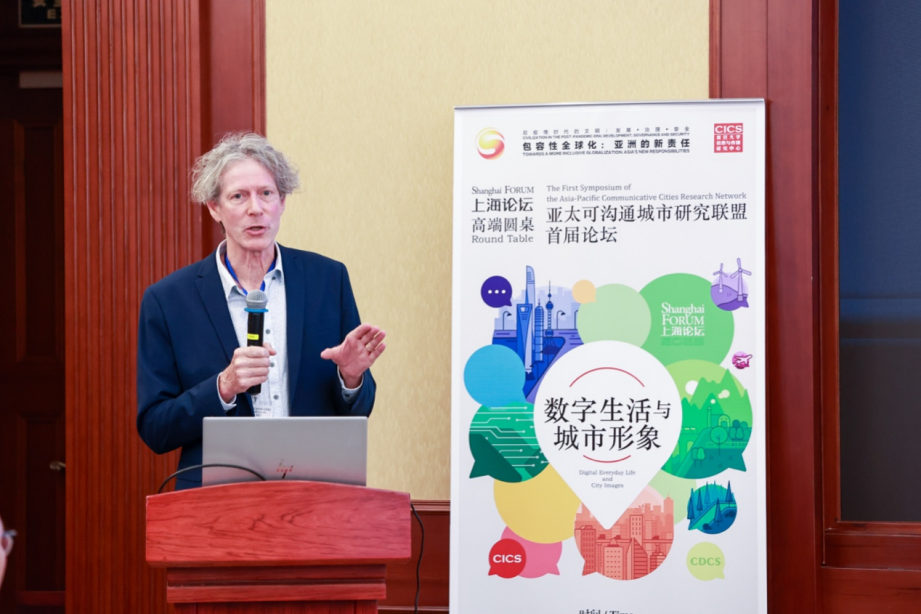
图为Scott McQuire教授在论坛上作主题演讲
作者简介:Scott McQuire,澳大利亚人文科学院院士,墨尔本大学文化与传播学院媒体与传播学教授。[版权声明]本文章发表于《国际大都市发展研究》2024年第1期。本文由作者授权发布,未经许可,请勿转载(个人转载不在版权限制之内)。如公开出版机构需转载使用,请联系刊发杂志及作者本人获得授权。[引用格式]Scott McQuire。Digital Art as Urban Communication,国际大都市发展研究,2024年第1期。